
.svg)
.svg)

.svg)


Published 2025/12/19 by Clara Silva da Costa, Lawyer, Professional Licence 45229L
Considering a move to Portugal? The D7 visa to Portugal may be the key to your residency. This visa is designed for individuals who are financially independent and can support themselves without working in Portugal. We'll cover everything you need to know about the Portugal D7 visa including eligibility requirements, application process, and benefits. The residence visa is obtained at AIMA previously known as AIMA - here is the official website for D7 visa.
The D7 visa exists on the immigration law since 2007 and is also commonly known as:
1. D7 visa to Portugal
2. Portugal retirement visa - considered one of the best retirement countries.
3. Visa for retirees to Portugal
4. Visa for people living off-income
Passive income for the D7 visa Portugal means regular money you receive without having to actively work for it. The Portuguese authorities want to see that you can support yourself in Portugal on an ongoing basis, which is why the D7 is often called the retirements visa Portugal.
Typical examples of accepted passive income include pensions, retirement payments, rental income, dividends, interest from investments, and similar recurring income streams. What matters most is that the income is stable, predictable, and already being received.
One of the most common mistakes applicants make is confusing passive income with savings. Savings, even large ones, are not considered income. They show financial strength, but they do not replace the requirement for regular income.
For the D7 visa Portugal, savings are supportive, not decisive. Another frequent misunderstanding is assuming future or planned income counts. Income must already exist and be clearly documented. A property you plan to rent or investments that might pay dividends later usually do not qualify until they are producing income.In simple terms, for the retirements visa Portugal and the D7 visa Portugal, passive income is money that keeps coming in regularly, while savings are just money you already have.
Knowing this difference makes the process clearer and greatly improves your chances of approval.
Non-EU citizens that are pensioners or retirees; people living-off stable income, such as:
1. movable property
2. Income derived of real estate - like rentals
3. Intellectual property
4. Financial investments, like dividends, bonds, income from trusts, income from ownership of companies.
1. To have a clean criminal record;
The minimum passive income requirement for the D7 visa Portugal is derived from the legal concept of meios de subsistência under Portuguese immigration law (Lei n.º 23/2007, de 4 de julho), which requires that a visa applicant demonstrate stable financial means sufficient to support themselves and any dependents without needing public assistance. This standard is set by government regulation with reference to the Portuguese minimum wage.
According to current regulations for 2025:
A single applicant must show a passive income of at least the Portuguese minimum wage, which for 2025 is €870 per month (equivalent to €10,440 per year)
If applying with a spouse or second adult, the requirement increases by 50% of that base amount for the second adult.
For each dependent child under 18 (or adult child financially dependent), the requirement increases by 30% of the base amount.
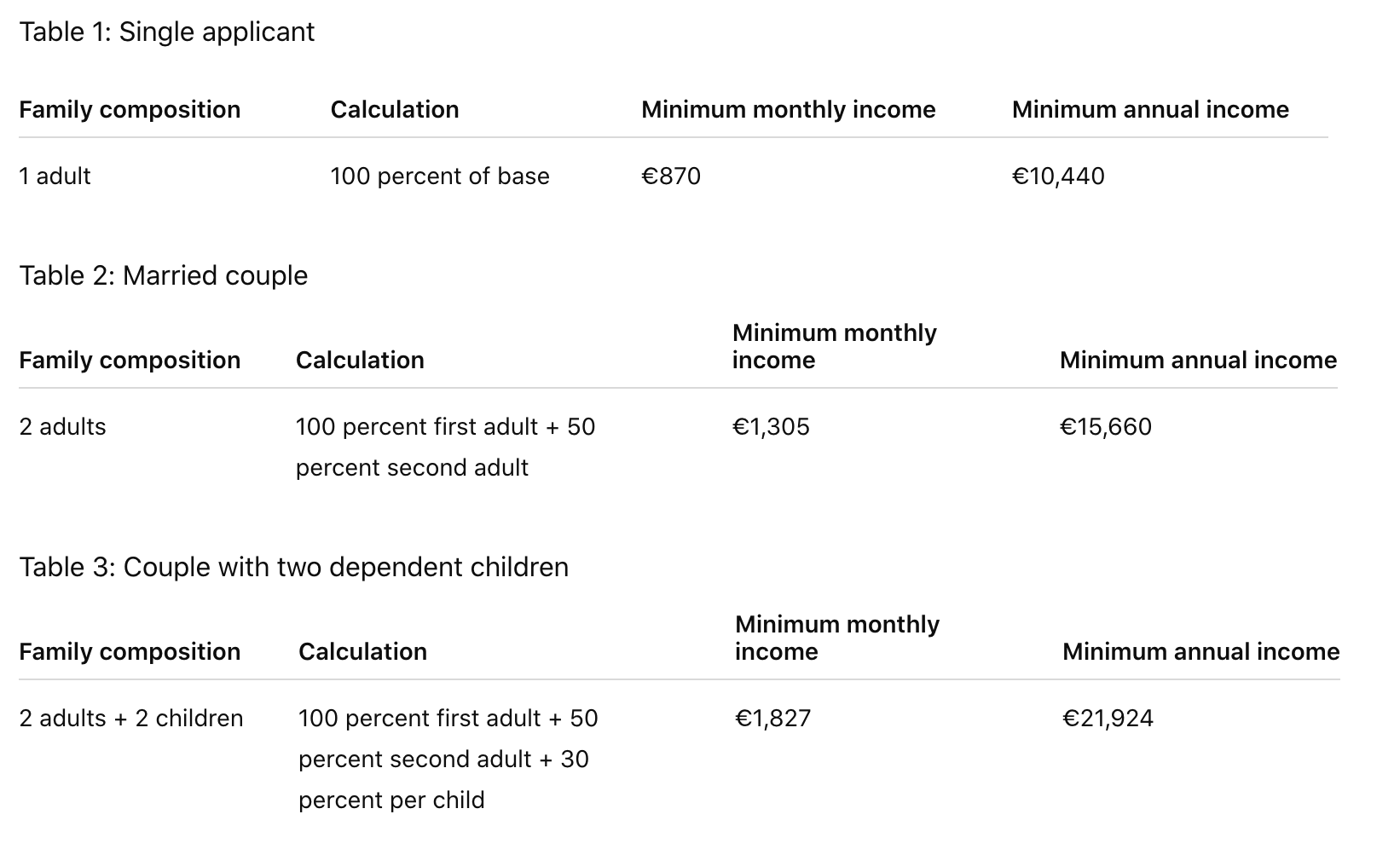
Created by Clara Silva da Costa, Immigration Lawyer, Bar Licence 45229L
Free Circulation
Permanent free entry and circulation in the Schengen Space, comprising 26 European countries.
Live in Portugal
Freedom to live in Portugal and, if so wished, to have a professional activity in this country.
Tax Benefits
Option to become anon-habitual resident of Portugal for tax purposes (little or no tax for 10 years).
Resident's Rights
Access to other Portugal residents’ rights, such as education, healthcare, social security.
The Portuguese consular missions and consular sections with jurisdiction within the area of the applicant’s current residence have the legal power for granting the Portuguese D7 visa based on the requirements.
The deadline for the decision or the processing time of the Portuguese consulate on the visa application is 60 days since an application with all forms and documents needed are submitted.
The consular service in charge must request a legal binding opinion, after the submission of the file from the Portuguese Immigration and Borders Police (SEF).
When an answer is obtained you will be requested to handle your passport to the embassy and new visa will be stamped on one of the pages of your passport.
To be able to apply for the D7 visa, requirements must be respected. As Portugal D7 lawyers we support clients in preparing a successfull aplication by dealing with the bureocracy of the paperwork and making sure it's according to the guidelines before submitting.
We will guide you through all paperwok needed, forms to fill and tax number to Portugal and Bank account / rental or property purchase.
The D7 visa is a residence visa that is intended to enable the holder to obtain a residence permit in Portugal. In this context, the visa is valid for two entries and entitles the holder to remain in Portugal for a period of 4 months, while the applicant waits in Portugal for a final resident permit issued by the immigration department.
First step:
the local consulate stamps a temporary D7 visa on your passport - processing time around 60 days.
Second step:
the applicant travels to Portugal on that’ D7 temporary visa and waits for the final visit to the immigration department to convert the temporary visa to a final D7 residence visa - processing time 60 to 90 days.
After you receive the D7 visa sticker in your passport from the Portuguese embassy or consulate, the process is not finished. That visa only allows you to enter Portugal and complete the final step, which is the residence permit appointment.
Step 1. Check the visa sticker
The D7 visa issued by the embassy is usually valid for 120 days and includes two entries. On the visa sticker you will normally see a reference to a residence permit appointment or an indication that the appointment must be booked after entry.
Step 2. Enter Portugal
You must enter Portugal while the visa is valid. The residence permit appointment can only be completed once you are physically in the country.
Step 3. Book the residence permit appointment
Residence permits are now handled by AIMA, Autoridade para a Imigração e Mobilidade, which replaced SEF.There are two common situations:If the embassy pre scheduled the appointment
Some consulates already assign an AIMA appointment date and location. In this case, the appointment details are either printed on the visa sticker or provided on a separate document. You simply attend on the scheduled date.
If no appointment was pre scheduled
You must book the appointment yourself after arriving in Portugal. This is done through AIMA’s official channels, typically by phone or through their online contact system. Availability can be limited, so this step often requires persistence.
The D7 visa issued by a Portuguese embassy or consulate is a temporary residence visa valid for 120 days.
This visa allows two entries into Portugal and exists solely to let the holder enter the country and complete the residence permit process with AIMA. It is not a residence permit and it cannot be renewed.
Once in Portugal, the holder must attend the residence permit appointment within the validity of the visa.After approval by AIMA, the residence permit is issued for an initial period of 2 years.
This first residence permit can then be renewed for a further period of 3 years, provided the legal requirements continue to be met.
In summary
Embassy D7 visa: 120 days, two entries
First residence permit: 2 years
Renewal after first permit: 3 years
For the D7 residence permit, Portuguese law requires a minimum level of physical presence in Portugal throughout the validity of the residence permits, both during the initial permit and the renewal period.Initial residence permit of 2 years
During the first two year residence permit, you must not be absent from Portugal for more than 6 consecutive months or 8 non consecutive months in total.
Renewed residence permit of 3 years
During the following three year renewal period, you must not be absent from Portugal for more than 6 consecutive months or 8 non consecutive months per year.
These presence requirements are cumulative and apply throughout the entire five year period leading to eligibility for permanent residence or Portuguese nationality.
In practical terms, over the full five years, you must maintain Portugal as your main place of residence and respect the absence limits for each permit period. Long or repeated absences beyond these limits can lead to refusal of renewal or affect future applications for permanent residence or citizenship.
Sources
Lei n.º 23/2007, de 4 de julho, artigo 85.º
Decreto Regulamentar n.º 84/2007, regras sobre ausências do território nacional
AIMA, Autoridade para a Imigração e Mobilidade, critérios de manutenção da residência legal
Members of the family of the holder of the residence permit obtained via a D7 visa are also entitled to a residence permit, based on family reunification statute.
No, a NISS is not required to apply for or obtain the D7 visa.
For the D7 visa Portugal, the legal requirements focus on passive income, accommodation, health insurance, a criminal record certificate, and basic identification documents. There is no legal requirement to hold a NISS at the visa stage or at the residence permit stage.
Why the NISS is not required?
The D7 visa is based on independent or passive income and does not depend on employment or contributions to the Portuguese social security system. A NISS is only mandatory when a person works in Portugal, is self employed, or is required to make social security contributions.
When a NISS may become relevant?
A NISS may be required later if the D7 holder starts working in Portugal, registers as self employed, or becomes subject to social security contributions. In that case, the NISS is obtained after residence is granted, not before.
Common misconception
Many applicants believe a NISS is mandatory because it is often required for employment based visas. This does not apply to the retirements visa Portugal or to D7 residence permits based on passive income.
Renewal of the D7 residence permit in Portugal follows a defined legal process and must be done before the permit expires. What is renewed is not the visa issued by the embassy, but the residence permit granted in Portugal.
When to renew
The first D7 residence permit is issued for 2 years. Renewal must be requested within the 30 days before the expiry date. Late renewals can lead to fines or refusal.
Who handles the renewal
Renewals are handled by AIMA, Autoridade para a Imigração e Mobilidade. In many cases, renewal can be initiated online through the AIMA portal. If online renewal is not available, an in person appointment will be required.
Without prejudice to the application of special provisions and other rights provided in the law or any international convention to which Portugal is a party, the holder of a residence permit shall be entitled to, without the need for a special authorization regarding his or her foreign status, the following:
If you want our assistance to apply for this visa, please contact us.
.svg)

.svg)
The Law Office works closely with Portuguese Registries Office - Conservatoria dos Registos Centrais, Conservatoria dos Registos Civis, the Immigration Border Agency, embassies and consulates. We represent clients from around the world who have the right to claim the Citizenship due to their relationship with Portugal.
.svg)
Avenida António Augusto de Aguiar, N. 183 1º Esq, 1050-014, Lisboa, Portugal


.webp)
.svg)
.svg)